

You’re not working, and you’re not retired either. You’re using an invested fund to cover a stretch of time that might last a few months, a few years, or until a pension starts. One useful name for this in-between stretch is a bridge account. Much of what’s written about this situation treats it as a lifetime pension question, and it isn’t one. It has a real end date, so it’s a fixed-duration funding question, closer to budgeting a long trip than planning a lifetime income, though some of these trips are much longer than others, as the three roads below make clear. Three very different roads lead to the same account, the same math, and the same real question: will it last long enough.
Maybe you stepped back on purpose, at a real turning point in your life. You looked at how you were spending your days and asked yourself whether you could actually live the life you had pictured for yourself, not just talk about it. That is a real privilege, not something everyone gets to choose. But it’s also a real scenario, and it works precisely because it pairs that pull toward the life you pictured with a fund, a spreadsheet, and a set of numbers that keep it honest.
Maybe you looked for work that matched your field and your level, didn’t find it, and decided you weren’t going to take something smaller just to have a job. Or maybe you just wanted a few years off, not a permanent exit from work at all. If any of that sounds familiar, and you have a real fund behind you, keep reading. This is written for you.
This article names the situation and gives you permission to stop feeling like an outlier. Part of what makes that low hum of “will this be okay” so persistent is a picture of slowly draining the fund to nothing. That picture isn’t the only way this goes. Depending on what you withdraw and what the fund earns, you can end up living mostly off what the fund produces, the “fat,” with the fund itself close to where it started, though it can also shrink or grow, depending on your own numbers.
Once that’s clear, the moral question mostly answers itself, and what’s left is one specific, answerable question: not “will this be okay” in general, but “how many years does this actually have to last.” That question, not a number, is what this piece hands you. The number itself comes later, once you bring that question to a calculator built for it. A specific question is something you can actually do something with. A shapeless worry is not.
That reframe, a fixed-duration question instead of a lifetime one, is the heart of what this article walks through: not the calculation itself, but what question you’re actually asking, and why the usual retirement advice doesn’t quite fit any of the three paths that lead here.
The Rest of the Series
This is one of a short series, each piece looking at a different angle of the same bridge-account picture: this one names the scenario itself. The others cover which expenses are easy to leave out of your monthly number, the 4% rule, what you want left in the fund when the money stops, when pension income starts, and what a bad market early on can do. Each stands on its own – start wherever is useful to you. The Savings Withdrawal Calculator was built for exactly this situation, to turn the questions ahead into an actual picture of your own numbers.
What This Article Covers (and What It Doesn’t)
This piece gives you a plain-words name for the situation, why it isn’t the retirement question it looks like, and the one question worth bringing to a calculator. What it does NOT do: the real numbers, the math, the year-by-year detail – those live in the rest of the series and in the calculator itself.
What Does It Actually Mean to Live Off Your Savings in a Bridge Account?
This section names the situation itself, before any label gets attached to it.
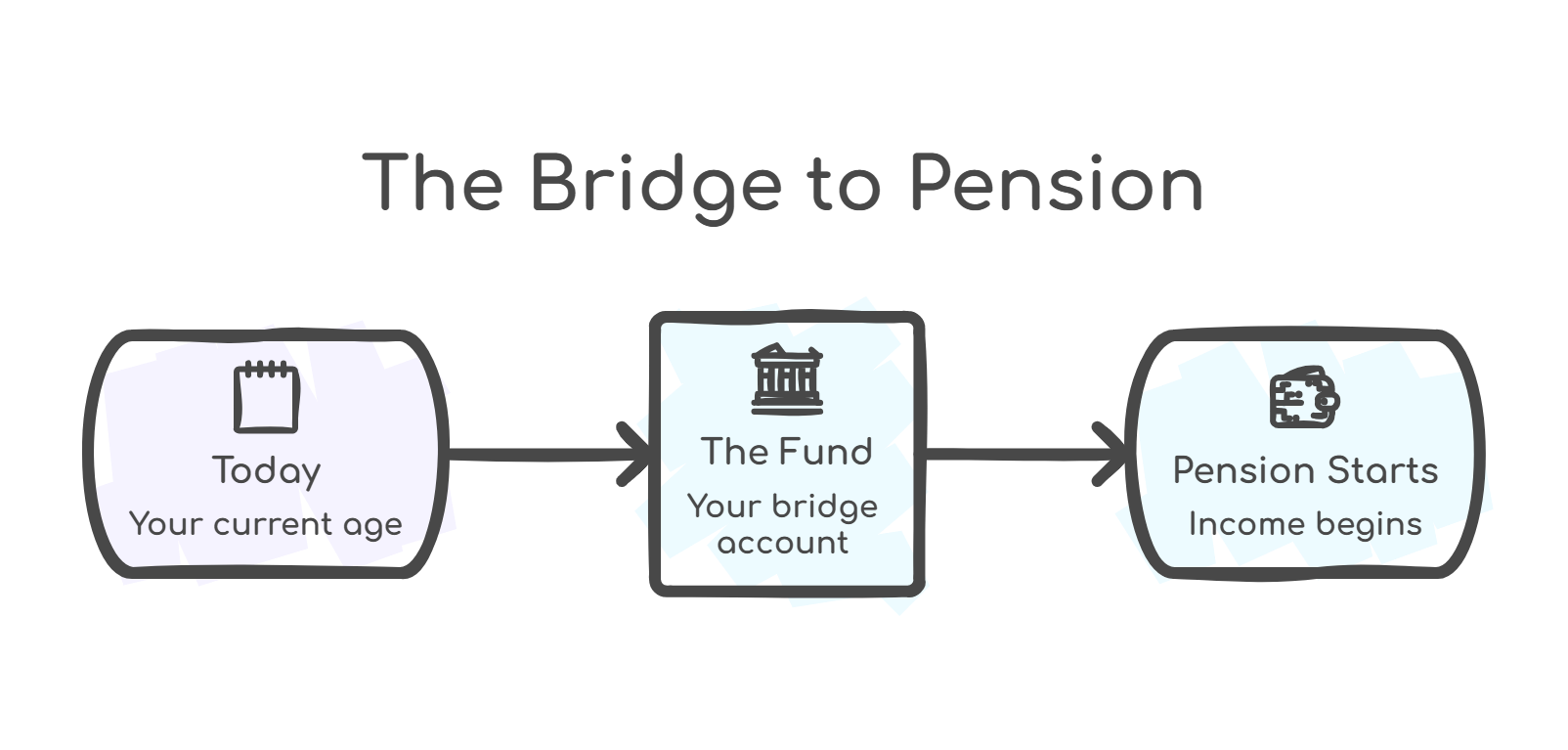
It means using money you’ve already saved to cover your monthly costs, instead of a paycheck or a pension. Not forever. For a stretch of time with a real, if not perfectly known, end date: the day a pension, a spouse’s income, or Social Security starts covering things instead.
That’s different from retirement in the usual sense. Retirement, as most people picture it and as most retirement math is built around, assumes an unknown, possibly decades-long stretch. This situation has a finish line. You may not know the exact date, but you know one is coming.
The reason it has a name, a bridge account, is that the fund is doing a specific job: bridging the gap between not working and the income that eventually arrives. It isn’t a special type of account. It’s whatever fund you already have, used this one specific way: a regular, planned withdrawal over a defined stretch of time. That’s what earns it the name. Once you can name it, it stops being a vague, anxious in-between and becomes a defined thing you can actually plan around.
There’s a picture that’s easy to default to here, and it’s worth correcting before going any further. The fund isn’t cash sitting quietly in an account while you slowly spend it down to zero. It’s invested, and how is your choice. A safer mix earns less, which means the monthly withdrawal leans more on the fund itself and less on what it earns. More risk aims for a higher return, with less certainty behind it. Either way, the money stays invested while you draw from it, so its value can rise or fall along the way.
That one fact changes the picture completely. If the fund only sat still while you withdrew from it, every withdrawal would be a straight step toward zero, and this really would be the slow erasure it can feel like. But because the fund is earning a return while it’s paying you, what you take out each month isn’t automatically eating into what you started with. Some of it, maybe even most of it, can be what the fund produced on its own, closer to a dividend landing in your account than a piece of the account itself going away.

Depending on how much you draw and what the fund earns, you could end this stretch with less than you started, with about the same, or with more. That’s not luck, it’s the real, calculable result of two numbers working against each other: what you withdraw, and what the fund earns. Which of those outcomes you actually get is exactly what the rest of this series and the calculator work out, not a guarantee, since nobody can fix next year’s return in advance, but a realistic picture built on a reasonable assumption, clear enough to decide from instead of guessing. For now, the point is simpler: this isn’t the story of watching a number shrink to zero.
It’s the story of deciding what you want to happen to that number, and having a real say in the outcome.
Naming the situation is only half of it, though. How you got here changes what it feels like, even when the underlying math doesn’t care, and that’s worth separating out clearly before going any further.
What Are Three Common Roads That Lead Here?
These three are common, not the only ones, but they cover most of the ground. Three people can hold the exact same fund, the exact same numbers, and be aiming at a completely different goal with it, because of how they got here.
Maya’s road runs until a traditional retirement, the closest of the three to what’s usually called early retirement. And early retirement doesn’t start on the day the paycheck stops. It starts on the day you actually know how the numbers hold up, not just for the first exciting months, but five, ten, twenty years out. Ryan’s and Priya’s roads are shorter and more temporary, a matter of months or a few years, not decades. Same math, different shape.
Maya chose it. She reached a point where she started asking whether her work was actually worth her years. Was she living by a script somebody else handed her: work your whole life, rest only at the end? Would she still be able to enjoy the things she cares about by the time a traditional retirement arrived? The question got blunter than that, too: is this all there is, working until the last day, or until you’re too worn down to enjoy any of it, or until your kids are already grown and gone before you really knew them?
She decided not to wait to find out. She checks her numbers once a month, the way you’d check the weather before a trip you already planned: out of habit, not out of worry.
Ryan didn’t choose it, not really. He looked for a role that matched his experience and his field, and it wasn’t there. He wasn’t willing to take a job well below his level, and that wasn’t only pride talking. He did the math: a job that paid a fraction of what he used to earn would have cost him time and energy for barely any income once he compared it honestly against living on the fund a while longer. The fund became the plan, not because he wanted it to be, but because the alternative genuinely didn’t add up.
Priya wanted neither of those. She wanted a few years off, a deliberate pause, not a permanent exit. Her question isn’t “can I stop working forever.” It’s “can this fund cover exactly this stretch, and let me go back on my own terms afterward.”
Same fund, same spreadsheet, three different goals: how much of the fund itself each is willing to touch, and how long each one needs it to last. Much of the early-retirement advice you’ll find is written with Maya’s situation in mind. It talks cheerfully about freedom, flexibility, financial independence. If you’re Maya, that tone fits fine. If you’re Ryan, that same cheerful tone can feel like a slap: you didn’t choose this, and being told to celebrate your freedom stings.
Looking at the exact same shrinking balance, Maya can think “this is the cost of the freedom I chose.” Ryan can think “I’m using up the time I bought while I wait for something to change.” The number leaving the account is identical. What it means is not.
Once the numbers are actually laid out, there’s usually still some worry in the background, but there’s room now for something else too: a plain confidence that the plan holds. That’s really what this piece, and the calculator behind it, are for, replacing a vague feeling with an actual picture. Ryan’s decision not to take a smaller role is his own to make, not something this article weighs in on.
What’s easy to miss is that all three are about to hit the exact same wall: the math underneath them was never built for their situation at all, which is the next thing worth untangling.
Why Doesn’t the Usual Retirement Math Apply?
This is the reframe that changes how to think about it, whichever of the three roads got you here.
Pension and retirement math answers a genuinely harder question: how much can you withdraw each year, forever, from a fund that has to last an unknown number of decades, because nobody knows how long they’ll live. That’s why the well-known rules of thumb run conservative. They’re insuring against the worst case: a very long life.
This situation isn’t that. There’s a real end date. Maya’s traditional retirement starts at a known age. Ryan’s Social Security eligibility has a known window. Priya is planning to go back to work by a date she’s already decided on. In all three cases, the fund has to cover a fixed, nameable number of years, not an open-ended, unknowable number of decades.
Think of it like planning a long trip instead of the rest of your life. You know where the trip starts. You know, roughly, where it ends. You have a set amount of money for it. You don’t know every expense along the way, prices shift, something unexpected always comes up, but you would never ask whether your travel money has to last forever. You’d ask whether it can carry you to the destination.
A bridge account works the same way. The real variables are the size of the fund, what’s coming out of it each month, how long the bridge actually is, and what happens to the money while it’s still sitting there, waiting to be spent.
Once lifetime-withdrawal math stops being applied to a fixed-duration problem, the whole shape of the question gets simpler.
That simpler shape is exactly what turns into a short, concrete list of questions, and it’s the same list for all three of Maya, Ryan, and Priya.
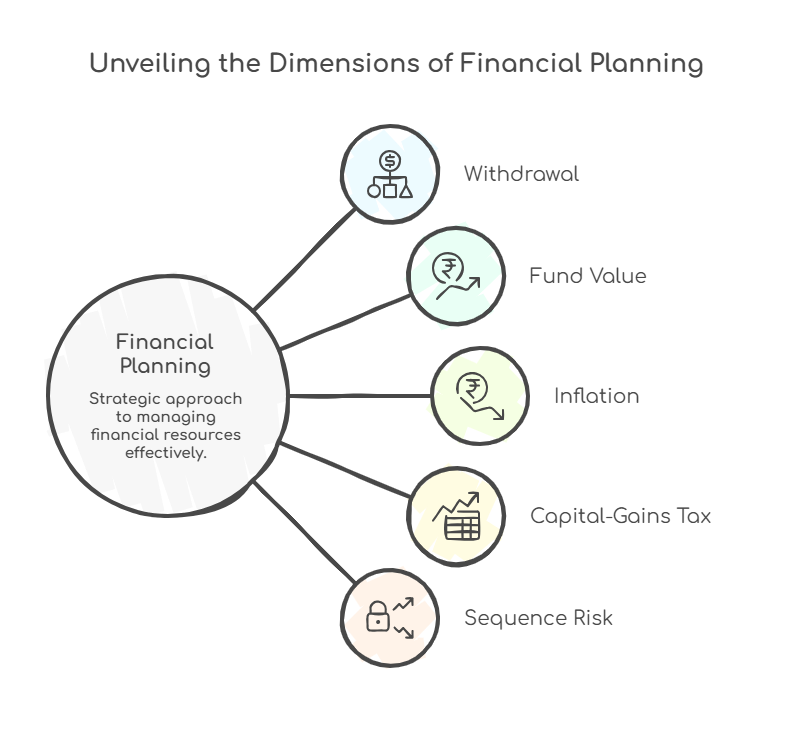
Five Questions the Math Actually Asks
With the reframe in hand, here’s what the question actually breaks down into:
- How much can be withdrawn each month, and for how long does that actually last?
- What is the fund likely to be worth after five years, or ten?
- What is a fixed monthly withdrawal actually worth once inflation has been chipping away at it for a few years?
- What does capital-gains tax take out of a withdrawal that comes from selling investments, not from a paycheck?
- What happens if the first year or two are bad ones for the market, since a downturn early in this stretch does more damage than the same downturn later on?
These five questions don’t sit in separate boxes, either. Pull on one and the others move. A higher monthly withdrawal shortens how long the fund lasts, which raises the tax bill in any single year, which speeds up how fast the fund shrinks, which leaves less cushion if the market has a bad stretch early on. None of the five is really independent of the other four.
Maya is really asking whether the number is enough at all, and whether the plan she’s stepped into is genuinely as good as it looked from the outside. Ryan is asking how much time he actually has before something has to change. Priya is asking whether the fund covers precisely the years she’s planning to be away, no more, no less.
Different framings of the same five questions. A calculator built around exactly this situation is what turns them from worry into a number, and it’s worth being honest about what that number actually is and isn’t.
Can a Calculator Really Tell You If Your Savings Will Last?
None of us enjoys sitting with interest rates, capital-gains tax, or the small details that can feel like they’re deflating a dream that took real courage to build. But that’s exactly the job a calculator does here: it grounds the picture in reality, and that reality can turn out to be a genuinely optimistic one. This isn’t just a single-answer calculator, either. It works more like a simulator, a tool built to try out different numbers and instantly see what each one changes. Plug in a different withdrawal amount, a different return, a different bridge length, and watch the whole picture shift, with several angles on the answer, not just one number. Because the decisions on the other side of this are big, and they shape both today and years from now, it’s worth pushing past the urge to skip the boring numbers, so the decision gets made from a place that’s informed, not just hopeful.
It’s worth being clear about what this tool does and doesn’t do here, before going looking for one.
It can show what the numbers do under a set of assumptions: the amount withdrawn each month, an assumed rate of return, inflation, taxes, and how long it’s asked to last. Change one input and watch what happens to the others. That’s actually useful. It turns a vague worry into a visible shape.
It can’t tell you which assumptions will actually hold. Markets don’t follow the average return plugged in, not exactly, not ever. It can’t make the decision, or promise it’s definitely safe. What it gives is a clearer picture to decide against, not a guarantee.
That’s not a small thing. It’s easy to carry this question around for a long time without ever seeing it laid out year by year. Going from nothing to a visible, adjustable picture is most of the distance.
This was never a lifetime question. It’s a duration question and an amount question: how long the bridge needs to last, and how much comes out of it each month. Both are answerable, and that alone makes the whole thing feel more solvable. The math doesn’t know or care whether the fund was chosen, forced, or picked on purpose for a few years. The number is the number. What differs between Maya, Ryan, and Priya is only how they feel about arriving at it, not what the fund actually has to do.
Whatever number a calculator hands back, it’s only as good as the assumptions behind it: the fund today, the monthly withdrawal, the assumed return, inflation, taxes, and how many years it’s being asked to cover. Get any one of those wrong and the number moves with it. That’s not a flaw in the tool, it’s just what “an estimate” means.
The one-line version, worth keeping.
This is a math problem with a real finish line, and the fastest way out of the anxious, shapeless version of it is turning “will this be okay” into specifics. Three things worth writing down today: how long the bridge actually needs to last (months, a few years, or until a pension starts), how much you want to withdraw each month (and whether that’s realistic for your fund), and what you’re willing to happen to the fund itself, touching it is fine, or you want most of it still there when the bridge ends. Then take those three numbers to the calculator and see what it actually says. That’s what turns the math from possible into real.
This article started with a shapeless worry, whichever of the three roads led to it. It ends with a name for the situation and the specific number worth finding next. The plan stays a feeling instead of a number for as long as it goes unmeasured, and that feeling lifts once you bring your own numbers to the calculator.
A few more questions, answered directly:
Does this apply if I’m still years away from retirement age?
Yes, if you’ve actually stopped working before then. Someone who is 57 with a pension starting at 67 is squarely in this scenario: there’s a real, nameable gap, ten years, between stopping paid work and the pension starting. What this scenario does NOT cover is someone who is still working now and only plans to retire, eventually, with no fund yet being drawn down. Once the paycheck actually stops and the fund starts covering costs, the gap is real, however many years long it is, and this scenario applies.
What if the plan changes and work starts again partway through?
That’s exactly what Priya’s version of this looks like, and it’s common. Going back earlier usually improves the projection, because the fund needs to cover fewer months or a smaller monthly shortfall.
Is a bridge account just another name for an emergency fund?
No. An emergency fund covers an unplanned shock. A bridge account is a planned, ongoing income source for a known stretch of time. Different job, different math.
Sources
- Charles Schwab – Timing Matters: Understanding Sequence-of-Returns Risk – backs the point that a market downturn in the first year or two of a bridge account does more lasting damage than the same downturn later on.
- Consumer Financial Protection Bureau – An Essential Guide to Building an Emergency Fund – backs the FAQ’s distinction that an emergency fund is for unplanned expenses, unlike a bridge account’s planned, ongoing income.