

How long will your savings last if you withdraw a fixed amount every month? This article answers that question, and shows you how to check it with your own numbers.
This article presents an interesting method: taking a monthly payment out of a sum of money we have (savings, an inheritance, and so on). A monthly withdrawal from savings lets us pay ourselves a fixed monthly amount that comes directly from the savings we have. I like to think of it as a way to pay ourselves a monthly salary from the money we already have.
At first glance, withdrawing money from our own savings shouldn’t deserve to be called a “method.” Anyone can withdraw money that belongs to them, and you don’t really need a “method” for that. But by the end of the article, you’ll understand the thinking behind the method, and you’ll be able to decide whether it can work for you, now or in the future.
I want to say this clearly: I am not an expert or an advisor. I’m just like you, and I want to show you some interesting possibilities. The decision is yours to make, on your own or with a professional.
To understand whether the idea of a monthly withdrawal from savings is relevant to us at all, or can serve our unique needs, we will need to pass through “3 doors”:
Door 1: The door of privilege
A monthly withdrawal from savings requires a sum of money, with the emphasis on a significant sum of money. If we don’t have that privilege, information about the method may be nice or interesting, but the amount we could pay ourselves won’t be significant. The method relies on a significant sum that can “grow” while also letting us “take” a monthly payment from it that serves our needs.
There is no minimum amount. But the larger the sum is compared to the monthly payment you want, the longer it will last, and it may even keep growing.
The reason is that for our savings to produce a meaningful return, or to let us “draw” a meaningful monthly payment, the principal itself, the sum of money we have, needs to be large enough for us to “work with it.”
Door 2: The door of the opinions, beliefs and associations each of us holds
A monthly withdrawal from savings seems to contradict (with the emphasis on “seems”) many of the common opinions and associations most of us hold. For example: what is the meaning or role of “savings,” how do we feel about “investing,” and do we think we are allowed to enjoy the present “at the expense of the future.” The article will present the common views most of us hold about these concepts, and at the same time, I want to add more information and other interpretations that can enrich or broaden our default way of thinking.
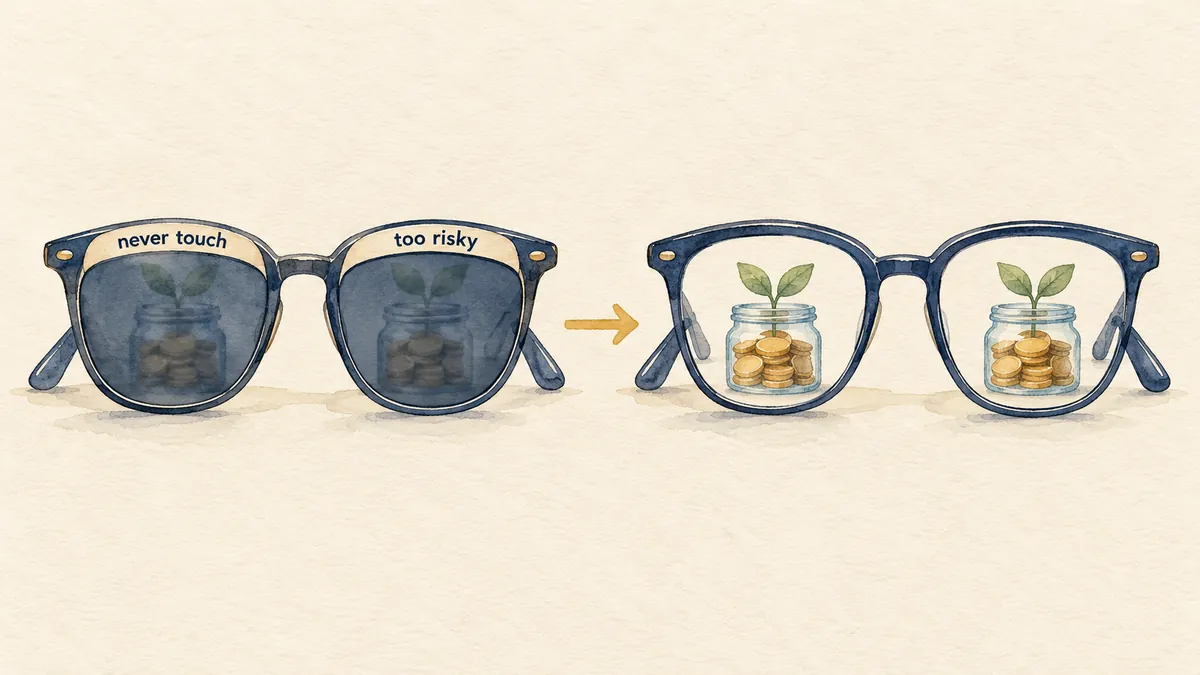
Door 3: Understanding the principles of the Systematic Withdrawal Plan (SWP)
The method can be used in several different scenarios. It’s a bit like a Swiss Army knife, with a different tool for each job: each scenario is meant to solve a different need, with different goals. Each scenario focuses on different needs and different constraints, and aims at different goals. So we need to get to know the different scenarios, so we can understand which one is relevant to us (if any), and whether a monthly withdrawal from savings serves our needs or fits the stage of life we are in.
Using a monthly withdrawal from savings is not an on/off switch that we flip up or down. Later in the article we will review the basic principles we need to define and make a clear decision about, so we can tailor a monthly withdrawal plan that best fits the unique needs of each of us.
The parameters we must address to find the right mix for us are:
- The amount of money I have
- The monthly payment I want to pay myself
- The period of time over which I want to receive the monthly payment
- What do I want to “happen” to the money at the end of the withdrawal period? For example, do I want the amount to keep growing, stay the same, or do I plan for the money to be used up by the end of the period?
Clarifying the terms we'll use throughout the article
A few terms and names to explain before we start
The name of the method
The common name for the method is Systematic Withdrawal Plan (SWP). An SWP is a method in which I “pay myself” a monthly payment that is drawn from a sum of money I have (in practice, that money can be uninvested or invested in different types of investments). I am both the one who pays and the one who receives, and I am the one who decides on the amount, the period, and what I want to happen to the savings. We’ll expand on this in the chapter on how it works.
The word Systematic emphasizes that this is a “method” with rules and guidelines, and not just a whim or an undefined plan based on impulse or a lack of planning. Throughout the article, we will mostly use a simpler name for the SWP method: “monthly withdrawal from savings.”
The idea of receiving a periodic payment from money we have already saved is not new. Some investments pay dividends, and some bonds pay interest on dates set in advance. A withdrawal plan like SWP lets us create a cash flow in a different way: by setting an amount we will withdraw from our savings every month. The difference matters: the withdrawal is not necessarily “fruit” that the investment produced that month. It can also come from the money we invested in the first place.
Other names for the same idea
You may come across similar ideas under other names. In the UK, for example, people talk about pension drawdown when withdrawing money from pension savings. In Australia, there is a framework called an account-based pension for receiving payments from retirement money. These are not identical to SWP, but they all deal with a similar question: how to use the money we have saved over time. A “bridge to retirement” also belongs in this picture. It describes a possible goal for the withdrawals, not a new method.
What does “monthly withdrawal” or “monthly payment” mean?

Where does the monthly payment come from?
The term “monthly payment” can be misunderstood, because the common association is that an outside body gives us the payment. What’s special about our method is that we ourselves are the “body” that gives the monthly payment, and at the same time, we are also the ones who enjoy receiving it.
A monthly withdrawal from our savings turns the money we have saved into a kind of income source. It is not a guaranteed annuity from an insurance company or a pension fund, and the amount can change according to our choices. Later we’ll present several different SWP scenarios, but the basic assumption is that our money will be “invested” and will produce a return, so the “withdrawal” can be based on:
- Part of the return our savings produce
- All of the return our savings produce
- A certain part of the savings themselves (how large a part depends on our plan for “what will happen to the savings”).
What does “savings” mean in the context of a monthly withdrawal from savings?
I chose the word “savings,” but it’s worth noting that for some of us, it brings to mind a piggy bank, or money locked in the bank for a fixed period at a guaranteed interest rate.
In this article, “savings” means a sum of money we have accumulated and can draw a payment from over time, according to the terms of the account or product it is held in.
If it’s an investment portfolio, the withdrawal means selling some of the securities in the portfolio. If it’s a mutual fund, the withdrawal means redeeming some of the units. If it’s a deposit or a savings plan, the withdrawal means taking out part of the money, according to the plan’s terms.
The second door: the beliefs, opinions and associations we hold about money, savings, investing, and enjoying the fruits of our money
Before we talk about the numbers and the technical details, it’s worth pausing for a moment to notice something that has a huge effect on our decisions: our beliefs, opinions and associations about things like savings, standard of living, or fulfilling wishes and dreams that cost money.
Most of us come with a fixed set of beliefs that create a clear picture of reality for us. In this part, I’ll present three such beliefs. The goal is to put our beliefs and associations on the table and pin down their real basis, while also adding more “layers of insight and understanding” that broaden our basic assumptions and the set of images we tend to use.
1. Savings are a locked box you never touch
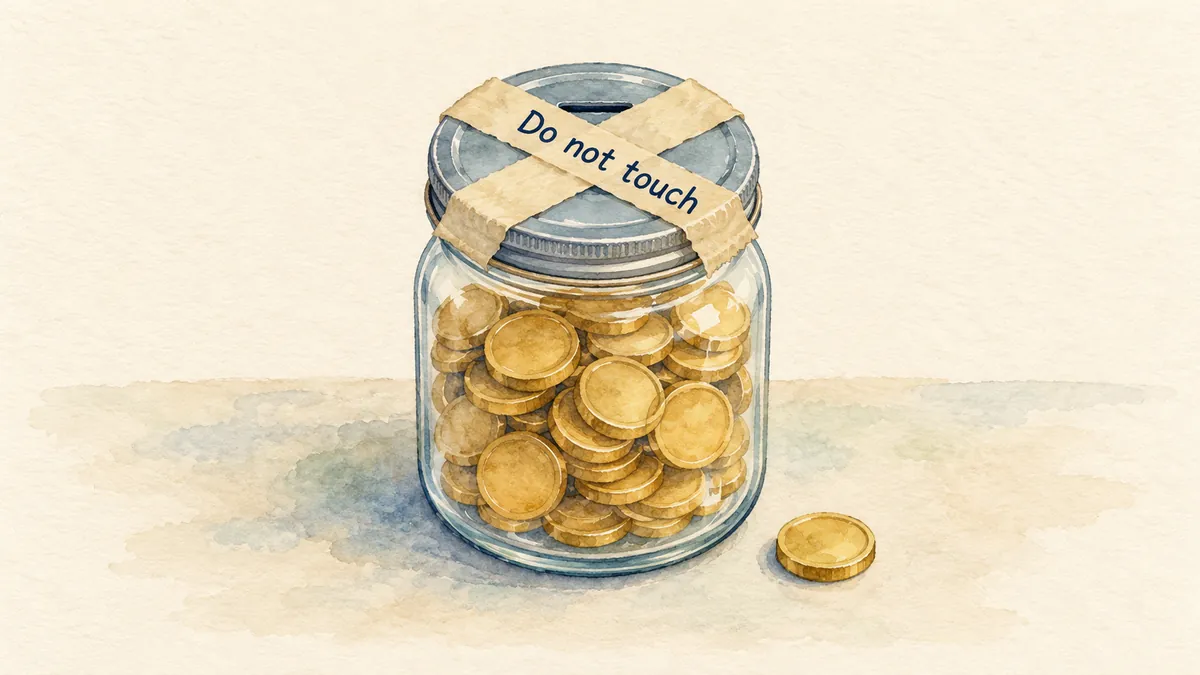
The belief: “Savings are meant for ‘saving,’ not for spending. I worked hard to save this money, and I need to keep it and protect it! Starting to spend my precious money and taking a monthly payment from it feels wrong, and feels irresponsible to me.”
Why it makes sense: First of all, I have to admit that I relate to this belief too. The basic purpose of savings is to have a sum of money available that has a clear, stated goal. For example, parents who want to save for their children, or the most basic purpose of savings: saving for a rainy day. Money has great power and meaning. For most of us, the money we save is a source of peace of mind and security. Knowing that if one day “something happens,” I’ll be able to use this money to deal with whatever “hard or challenging situation” I have to face. And I’m not alone: a study of about 2,500 American households found that retirees spend their guaranteed income easily, but touch their savings very little. For married couples aged 65, about 2% a year.
More perspectives:
- Look at all your assets, not just one savings account.
We usually treat “savings” as a single thing. For example, a sum of money I saved. The economist Richard Thaler showed that we put money into separate “drawers” in our heads: emergency money, vacation money, money for the kids. We treat each drawer differently, even when it’s really the same money. But in many cases (people who have already come a long way financially, meaning they are in a good financial position or better), “savings” is not a single thing. We may have built up several “financial safety nets” beyond our pension money: real estate, different investment options, money set aside in several places, and so on. So in that case, when I consider a monthly withdrawal from savings, we need to see the full picture. What is the total of the assets I have, and do I have enough assets to feel safe “using” an existing pool of savings as a source or tool for monthly withdrawals for different goals. - Withdrawing a monthly payment does not automatically translate into damaging or wiping out my savings.
“Withdrawing a monthly payment” can mean different amounts, and different ways of treating “the savings we have.”
You can plan a small withdrawal that aims to keep the value of your savings, or a larger one that slowly uses them up. In the chapter on the slider, we’ll see the whole range. - The purpose of savings doesn’t have to be only for a rainy day. You can also enjoy the fruits, or some of the fruits, of your savings in the present. Life isn’t aimed only at “one dark moment that will come in the future.” You can also partly enjoy a monthly payment from your savings right now, and add more experiences or moments of fun to our present.
2. I’m not royalty. Who am I to withdraw from my savings just to enjoy myself?
The belief: “I care about and am committed to my children and loved ones. I need to take care of my children’s future, and not waste the money (their money, my loved ones’ money).”
Why it makes sense: Wanting to take care of my children and leave money to the family is an important and legitimate goal.
More perspectives:
Our brain likes to think in “black and white, all or nothing.”
The idea of saving more and more money for my children’s future is based on the assumption that “one day,” maybe even when I’m no longer here, they’ll be able to enjoy the money I leave them.
I have a question that may make you a little uncomfortable: what about the “present”? Does it matter too, or is the only time that counts some unclear point in the future?
What about an option where we keep the savings and don’t plan to damage them, but also allow ourselves to enjoy part (only you can decide which part) of the fruits of the returns they produce for us?
What about collecting experiences in the present too?
A monthly withdrawal can be used to add to an existing income, such as a salary. In this case, the goal is to improve our standard of living. Not to make a 180-degree change (living off savings, for example), but simply to add more money to the salary we already have. Money has the power to create experiences and well-being for us. Life is not a dress rehearsal, and we are allowed to enjoy it when we have the ability to.
If I set aside an amount for myself and my family that lets us live a bit more comfortably, treat ourselves, or fulfill small dreams in the present, without damaging the original amount (or with minimal damage), is that really irresponsible? Using part of the money in a calculated way doesn’t cancel our responsibility to the future. We can be responsible, work with numbers, and still enjoy the present.
Maybe we can adopt the image of a fruit tree. I plant a seed, water it, protect it from pests, and look after it. And one day the tree returns the favor, with tasty, juicy fruit. I can enjoy the fruit without harming the tree or uprooting it. I keep caring for the tree, and it keeps giving me fruit. In our case, the tree is my sum of money (savings, money I received, and so on). I’m supposed to look after it, protect it, and let it grow and flourish (investing the money), and in the future I’ll be able to enjoy the fruit it gives me. The fruit is the return on my money. And it’s perfectly fine to enjoy it, instead of looking at it from a distance without touching.
3. Investing your savings is dangerous. Investments are a gamble, and you can lose everything in a second
The belief: “Investing is dangerous!” “Playing with my money could wipe out all my precious money at once.”
The first association we have with the word “investing” has a huge impact on how we relate to investments. One common association is that investing = risk, danger, recklessness, fear. Sentences like: “I’m not a money person,” “I don’t understand anything and I could easily be cheated,” “my neighbor lost everything he had in the stock market,” “investing is like gambling at a casino, and I’m not a gambler!”
Why it makes sense: There is a basis for all of these associations. There are very speculative investments that can wipe out everything we’ve saved or earned. Not all of us “specialize” in investing or know the field in depth. Sadly, there are also stories of scammers who tricked people and took their money. There is real risk in volatile investments, and this is a completely reasonable concern.
A loss hurts us more than a gain of the same size. That’s why it’s easy for us to see only the risky investments, and forget that there are also investments with a reasonable return, without too much risk.
For example: the psychologists Daniel Kahneman and Amos Tversky showed in prospect theory that a loss hurts us more than a gain of the same size. That doesn’t mean the risk isn’t real. It explains why the possibility of losing affects our decisions so strongly.
Another perspective:
The word “investing” is an umbrella term that describes a “whole universe” of investment types, from the most conservative and boring investments to exotic investments with a high level of risk. We’ve already said that the brain likes to think in black and white, so for some of us, the word “investing” immediately translates into the extreme end!
For some people, the association with the word “investing” is so negative that they prefer to keep their money in a checking account, uninvested (not earning anything).
So let’s talk for a second about the option that doesn’t do our money any good: “not investing,” or keeping the money in a checking account. A checking account has a price that is hard to see. We feel safe, but that feeling isn’t accurate.
Money that isn’t invested gets eroded over time by inflation. An explainer from the International Monetary Fund explains it: when prices rise, the same amount buys less. So even when I feel my money is safe in the bank, I’m actually losing a little of it almost every year, and over the years, the bite of inflation becomes significant. There’s a saying: if you’re not moving forward, you’re moving backward.
That doesn’t mean a checking account is always a mistake. For an emergency fund, or for money we need in the near term, having the money available and safe matters more than the return.
I, for example, left my money sitting idle for years and missed the chance to grow it. Since then, my personal opinion is that even the most conservative investment is usually better than money sitting idle. Modern financial institutions offer us a wide range of investment types, which lets each of us find our own “comfort zone” in terms of risk versus return.
“Investing” can mean many kinds of investment options. There are options with relatively low risk, such as a deposit, a money market fund, or a government bond held to maturity. There are products whose risk depends on what they hold, such as an exchange-traded fund (ETF) or an insurance company savings plan. And at the other end, individual stocks. Each of these options differs in its level of risk, how available the money is, its management fees, and so on.
So you should make the decision after consulting a trustworthy professional who can see your full financial picture, the goals you want to achieve, your constraints, and most important of all, your tolerance for investment risk.
There is no investment with 0% risk, but there are investment options where the risk of losses (a negative return) is relatively low or close to zero, such as a bank deposit (savings with an interest rate guaranteed in advance), or a government bond held until its maturity date.
Even if you decide you’re willing to take more risk to increase your return, you can split it: part of the money in a conservative, very low-risk investment (with a correspondingly low return), and part in a higher-risk investment. For example, investing in a broad stock index lets you buy “the market” without choosing or betting on a specific stock. The money is spread across many companies, so the failure of one company doesn’t wipe out the whole investment. Diversification doesn’t prevent losses, but it reduces dependence on any one company, as the U.S. Securities and Exchange Commission explains.
Important note: the information presented about investment options is a general overview, not a recommendation. I do not recommend any specific option. What’s written here is meant to explain and illustrate, and in no way replaces investment, tax or financial planning advice. Every decision should be based on your personal situation, and it’s always recommended to consult a qualified professional.
The third door: how the method works
The mechanics: how the monthly withdrawal works in practice
The idea: planned use of money
One of the unique features of this method is that whoever uses it “wears two hats”: they enjoy the monthly payment, and they are also the “owner” of the savings the payment comes from. That’s why the planning stage is so important. The decisions you make will translate into clear numbers: the monthly payment amount, the time period, and what will happen to the savings at the end. There are also other decisions, such as the investment option (which will strongly affect the gain or loss), and when to change the payment, for example if the savings didn’t earn as expected, or to adjust it for inflation.
What it looks like day to day
You can make the monthly withdrawal on your own: log in to your account once a month, or once a year, and withdraw the amount you set. In some countries and at some financial institutions, there is also a service that does this automatically. It isn’t available everywhere, so it’s worth asking your bank or whoever manages your money.
With a service that withdraws the money automatically, you set two things: how much money to receive, and how often (for example, on the first of every month). From then on, the system does the work: depending on the type of account, it redeems units or sells some of the investments, and transfers the amount to your bank account.
The big advantage is that you don’t have to remember to do it every month. But it’s important to remember: automation only moves the money. It doesn’t know whether the amount you chose is right. You need to decide that in advance, and check from time to time whether it still fits the state of your savings and the purpose of the monthly payment.
The scenarios where you can use a monthly withdrawal from savings
Four building blocks
To plan ahead “properly,” we first need to clearly define the category and the specific scenario that fits our needs. The choice of scenario will fully determine all the different parameters that make up the actual use of an SWP.
To better understand the different categories and scenarios, I want to present the main elements we will need to define in advance, according to the chosen scenario.
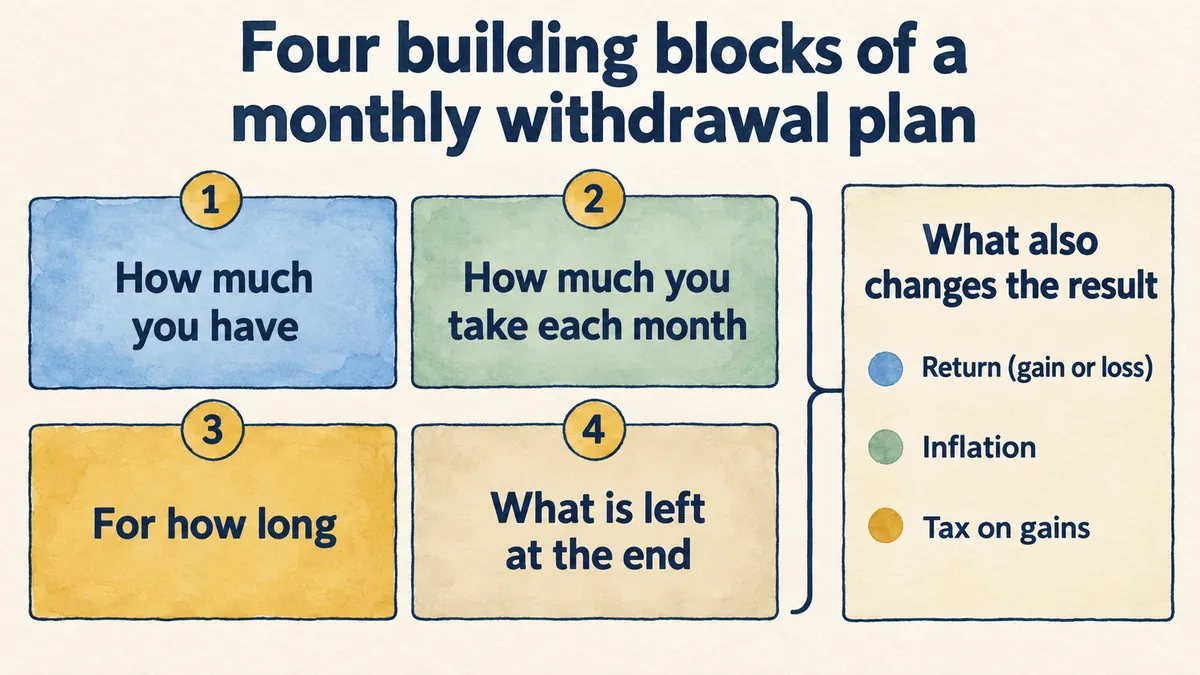
We already met the building blocks at the start: the amount of money, the monthly payment, the time period, and what will be left at the end.
There are other elements we haven’t mentioned yet, such as:
- The rate of return (the gain or loss on the savings)
- Inflation
- Capital gains tax on the part you sell each time.
With the four building blocks, you can build different recipes, according to the scenario that fits each of us. For this article, I’ve divided them into two categories.
Category 1: Retirement and long-term planning
What the scenarios in this category have in common is retirement, meaning retiring from work. Some scenarios last for decades “into retirement” or are a solution for the retirement period itself, and others end the moment the pension begins.
- Bridge to retirement (Pre-Retirement Income Bridge): You stop working, or slow down, before retirement age. The withdrawals have a clear end point: the day the pension, or another income, begins. The question is not only how much you can withdraw each month, but also how much you want to be left at the end: the whole original amount, part of it, or nothing.
- Savings that become a monthly income instead of a pension (Self-Funded Retirement): Private savings are the main source of income for the rest of your life, because there is no pension or it is very small. Here the money needs to last for the rest of your life, so the central question is how long it will last. This is a more complex scenario that also depends on life expectancy, inflation and tax, and it requires much more planning with a qualified professional than the other scenarios.
- Adding to an existing income (Income Supplementation): There is a fixed income, a salary or a pension, but we want a bit more (dessert after the main course). For example, someone who is still working and wants an extra amount to improve their standard of living until retirement, or someone who is already retired and whose pension isn’t enough for the standard of living they want. The goal is not to replace the existing income, but to add to it.
In each of these scenarios, there is another element worth considering: the choice between a fixed monthly payment, or a dynamic, flexible amount that changes with the market. For example: withdrawing less when the stock market falls, and more when it rises.
Category 2: Income for a shorter period (Temporary Financial Bridge)
Here the goal is not retiring from work, but taking a break in the middle of life’s race. The period is shorter, and the considerations are different. Here too, there are two types:
- A bridge with a known end date (Defined Timeline Bridge): You know exactly when the period starts and when it ends, so you can plan a precise budget. For example, a sabbatical, a two-year trip, or a period of study. Example: someone who decides in mid-life to take a year-long trip around the world with the family, or to stop for a year to write a book, with a clear intention of returning to work at the end.
- A bridge without a known end date (Contingent Bridge): You don’t know in advance how long it will take. The goal is to temporarily replace a regular income. For example, between jobs, during a career change, or while starting a business. Here it’s important to check not only the withdrawal amount, but also how long the savings will last if the period gets longer.
How much will your savings grow, and what can't be known in advance
In a perfect world, we would have a magic wand that let us know in advance exactly how much we would earn on our money, and lock in that gain. In other words: a scenario where our money only grows and never shrinks. Sadly, we don’t have a magic wand, but the market does offer types of investments that let us know the return in advance with fairly high certainty. A hint: these options usually won’t let us enjoy large gains. We buy peace of mind, security, or the ability to predict the future, at the price of a relatively low return (low risk and low return).

With some savings plans, you can know the return in advance. For example, a bank deposit: we commit to lock the money away for a certain period, usually without touching it or only with a penalty, and at the end of the period, the bank commits to pay an interest rate set in advance.
With bonds, you can also know the return in advance, but only if you hold the bond until its maturity date, which can be years or decades away, and the issuer pays as promised. If you sell the bond before maturity, its price can be lower or higher than you expected.
With all other investment options, you can’t know the return in advance, or the losses. You can guess, estimate, and use historical data and statistics, but no method can guarantee what the return will be. So it’s wise to be cautious about any attempt to predict it.
There’s one more thing worth knowing when you withdraw money every month from a volatile investment: it’s not only the average return that matters, but also the order in which the good and bad years arrive. If the market falls in the first years of withdrawals, you sell more units at a low price, and the savings struggle to recover even when the market rises again. BlackRock explains this well. This is called sequence of returns risk.
What happens to the savings themselves: keep them, shrink them, or use them up
Where does the monthly payment come from?
There’s a kind of paradox here. If I take a fixed amount from my savings, common sense says I’ll eventually use up all my savings. Reality is more complex, because while I’m withdrawing, the money that stays invested can keep earning (and can also lose).
One thing is worth clarifying here. You can withdraw less than your savings earn, and then their value is kept, or more, and then they shrink. The option we choose has a big effect on what happens to the savings, together with returns, tax, costs and inflation.
What’s left of my savings, and how much is the monthly payment: a slider, not a switch
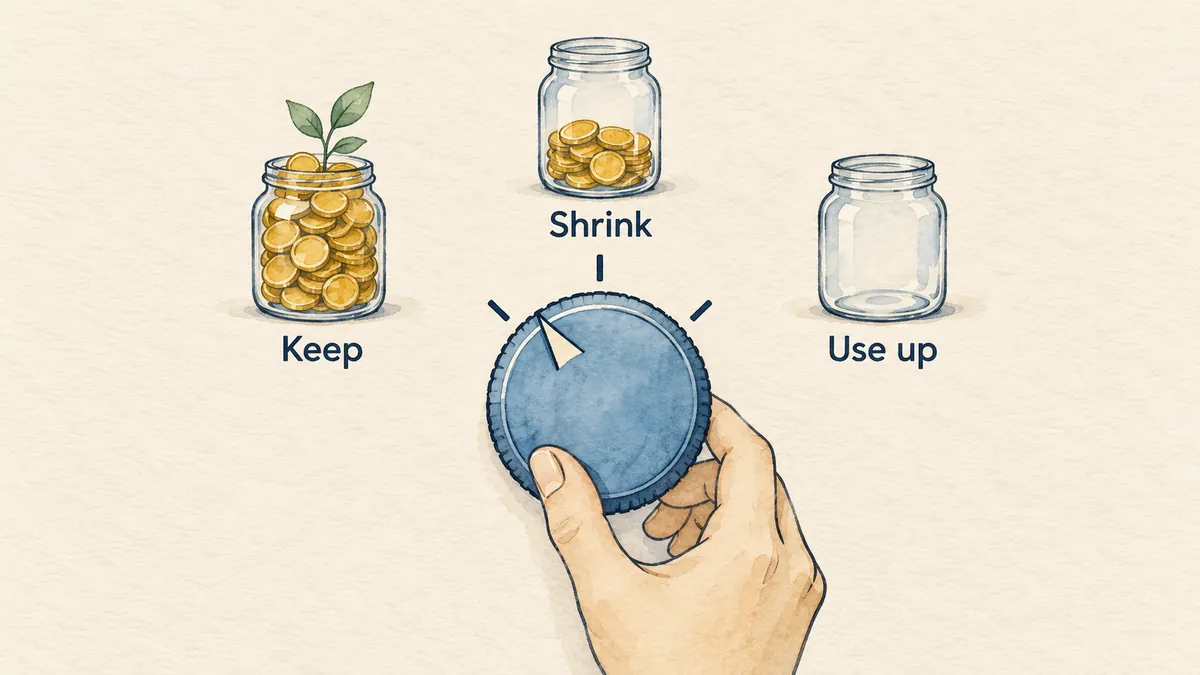
Choosing the monthly payment amount, and what will be left of the savings, is not an all-or-nothing switch. It’s more accurate to imagine a slider: at one end, you keep the original amount as much as possible; in the middle, you accept that the original amount will shrink a little; and at the other end, you plan in advance for the savings to run out by a certain date. Where we sit on the slider depends on what matters to us: whether we have other sources of money, how much we want to keep aside as a safety net, how much we want to leave to our loved ones, and more.
- One end, keeping the original amount (Capital Preservation): You plan for the monthly withdrawals not to exceed the return over time. In professional terms, this is exactly income from capital: living off the fruit, without cutting branches off the tree. Charles Schwab explains that relying only on interest and dividends may make the payment too small, so they suggest also including a moderate sale of investments. That doesn’t guarantee the amount will be kept either. And remember: even if the amount stays the same, inflation erodes its buying power over the years.
- In the middle, keeping part of the amount: You withdraw a bit more than the savings earn, and the original amount shrinks gradually.
- The other end, using up the savings by plan (Capital Depletion): You withdraw more than the savings earn, so the savings go down gradually until the target you set. This fits a goal with a clear end date, such as a bridge to retirement, or someone who has other financial safety nets, such as other money or real estate. But it requires cautious assumptions about returns, inflation, tax and the length of the period, because a change in any of them can bring forward or delay the moment the money runs out.
A separate decision: how the monthly amount will be set: a fixed amount, an amount that rises with inflation, or a flexible amount based on rules. With flexible withdrawals, you withdraw less in weak years and more in strong years, within limits you set in advance. Vanguard describes a method like this, with a floor and a ceiling on changes to the amount.
You can also change your choice along the way: withdraw more when the need is greater, and less when it’s smaller.
A numerical example of a monthly withdrawal from savings
We’ve talked a lot about theory and concepts, but to illustrate the decision-making process and how we define the different elements of a monthly withdrawal from savings, we’ll use an example with “numbers” and see how to use the Savings Withdrawal Calculator I created for this purpose.
Our scenario is based on the following data:
David has savings of $500,000. David has other financial safety nets as well (real estate, for example), and he has a steady job with a good salary. David has planned his financial future fairly well, and when he reaches retirement age, he will have a pension that covers his needs and the standard of living he wants for himself and his family.
David read an interesting article about the monthly withdrawal from savings method (let’s say it was my article 🙂), and he is thinking about a scenario in which he enjoys part of the fruit his investment, meaning his $500,000 of savings, can give him.
David wants to give himself a “bonus” of $1,000 every month. The purpose of the “bonus” could be to allow himself and his family another interesting vacation somewhere in the world, or other experiences he wants to create for himself in the present. David is 57, and he plans to retire at 67.
David’s plan is to enjoy the monthly payment until retirement age, and when he reaches retirement age, to live on his monthly pension payments.
David places great importance on the idea of “savings,” and he doesn’t want to harm his savings principal, and perhaps also wants to let it keep growing. In other words, to have the best of all worlds: to maintain his existing savings, which represent security and peace of mind for him, and also to enjoy part of the returns in the present.
In the article’s terms: David is in the “adding to an existing income” scenario, and at the “keeping the original amount” end of the slider.
The summary of the scenario’s financial data:
- Savings of $500,000.
- The money is invested in a balanced portfolio, and we assume that a 5% return each year is a reasonable return.
- David wants to enjoy a monthly payment of $1,000 every month.
- The monthly withdrawal period: 10 years.
- Tax on gains: 15%. This is an assumption for the example, and a common rate in the U.S. The actual tax depends on the type of account, your income, and how long you held the investment.
- Annual inflation: 2.5%
The calculation assumes: monthly growth that adds up to 5% a year, a withdrawal at the end of each month, $1,000 net after tax, 15% tax only on the gain portion of each withdrawal, no management fees, and a starting value of $500,000 with no earlier gains. The final balance is before tax on selling the whole portfolio.
The main question David wants to ask is:
“Will the plan of withdrawing $1,000 every month let his savings keep growing, or at least not shrink?”
To show how to enter the numbers and get information, we’ll use the
Savings Withdrawal Calculator.
Note that the calculator’s “results” are divided into 2 parts:
- The “simple” answer, a direct answer to the question of the user entering the data (labeled Your estimate)
- The “expanded” answer (labeled Show me what else my numbers reveal)
What’s special about the expanded part is that the “answers” shown to the user include more information and topics worth considering beyond the basic answer. They let you understand the big picture, and more pieces of the puzzle you may not be aware of.
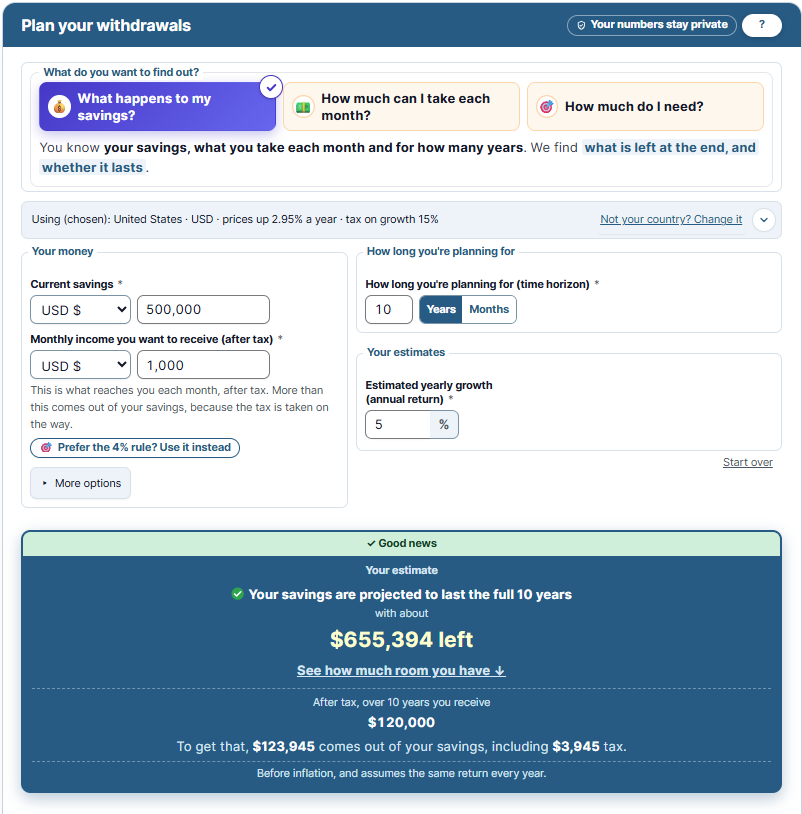
The line under the three questions shows the calculator’s default for the United States, prices up 2.95% a year. For this example we changed it to 2.5%, using Not your country? Change it. The amount left after 10 years does not depend on inflation, so it stays the same.
Question 1: How much will be left in the savings after 10 years?
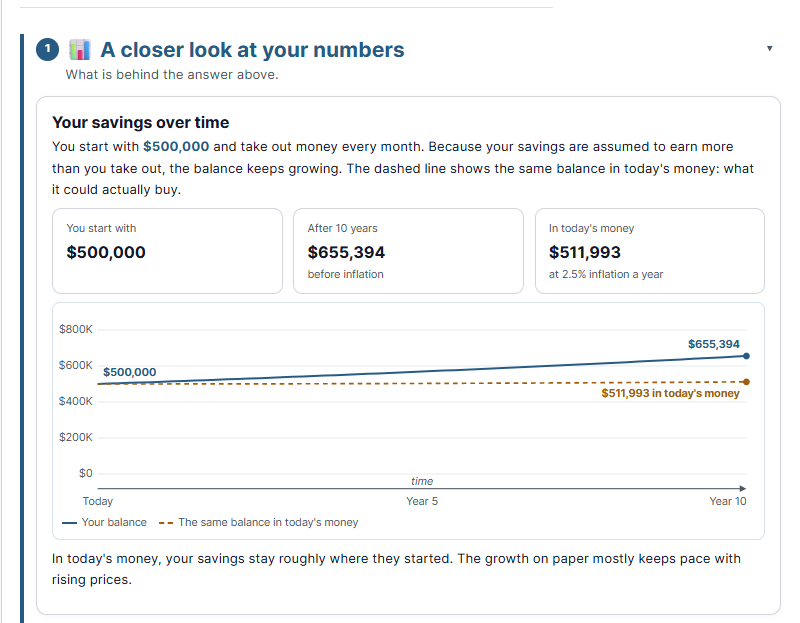
Based on these numbers, in 10 years there will be about $655,394 in the savings. It may sound a little strange that the savings were not only unharmed, but even grew by $155,394, even though David withdrew a fixed amount every month.
David withdraws less than the savings earn, so the value of the savings stays higher than the amount he started with, even if each withdrawal includes a bit of the original money and a bit of gain.
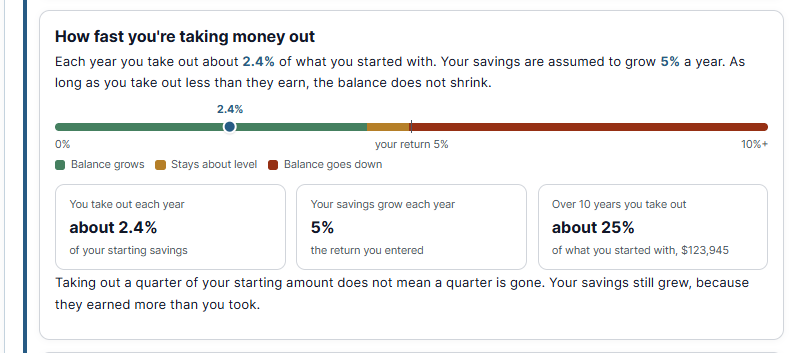
$1,000 a month is only 2.4% of the savings per year, less than the 5% return.
The money that stays invested earns more than David “spends,” so the savings keep growing.
Remember the belief that you never touch your savings?
This example shows that sometimes you can touch them and still protect them. But remember: this is the result of a model, with a fixed 5% return every year and no management fees.
It is not a forecast with full certainty.
For example, nobody guarantees that David’s savings will keep earning 5% every year.
In other words, under these conditions, David’s savings don’t just last 10 years, they grow.
The next parts are questions David “didn’t ask,” but when we look at the additional information, we’ll discover important points we barely mentioned in the article and didn’t think about. That is exactly the role of the “expanded answer” in the calculator, so it’s recommended not to settle for the basic answer.
Question 2: How much did I actually withdraw over 10 years?
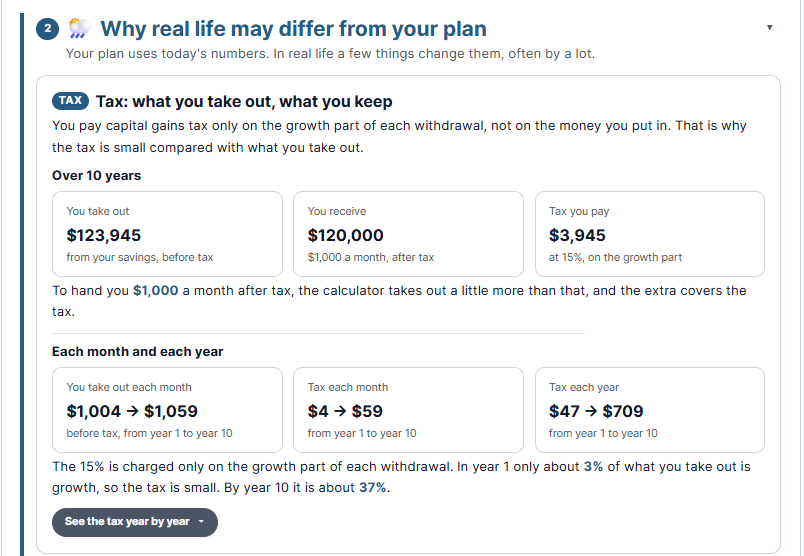
The answer is $123,945. At first glance, the answer should have been $120,000 ($1,000 times 120 months).
The new question might be: where do the extra $3,945 come from?
The answer is the tax on gains (which most of us prefer to ignore).
To get $1,000 net in hand, you need to withdraw a bit more and pay tax. But, and this is important: the tax is only on the gain, not on the money you originally put in. In each withdrawal, only the part that is gain is taxed.
In the first year, there is almost no gain in the savings (about 3% of what David takes out), so he withdraws only about $1,004 a month before tax. In the tenth year, about 37% of what he takes out is gain, so he withdraws about $1,059 a month. So over 10 years, the tax adds up to only $3,945.
Question 3: And what is that worth in today’s money?
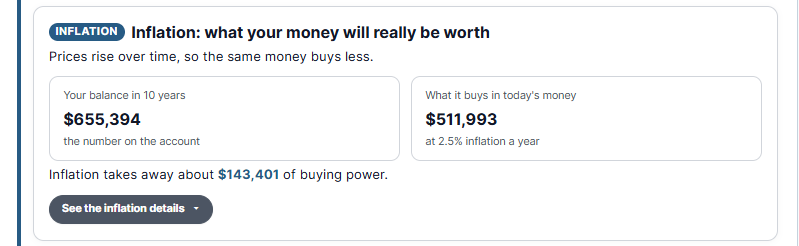
Notice that the answer to the question of what my savings will be worth in 10 years was that there will be about $655,394 in the savings. That sounds good, even very good, but what we’re not aware of is that inflation “erodes” our money over the 10-year period. It’s important to say that the 2.5% annual inflation figure is “only an estimate.”
Nobody can really know what the inflation rate will be. In practice, inflation can be higher, so the savings erode faster (the money’s buying power shrinks).
For example:
If inflation is 2.5% a year, in 10 years $655,394 will buy only what $511,993 buys today. In other words, in buying power, the savings grew by only about $12,000, not $155,000. The original amount was kept, but just barely.
It’s important to note a few things we left out to simplify the calculation:
- Nobody guarantees a fixed 5% return. The return depends on the type of investment and on factors we have no control over. In the calculator too, you enter your own estimate of a fixed average annual return. The calculator does not simulate alternating good and bad years. It doesn’t guarantee that the amount you chose is safe; it shows what will happen if your assumptions hold. It also doesn’t replace full retirement planning.
- The effect of inflation on the monthly payment was not included. In the example, $1,000 stays $1,000 even in the tenth year, but in the tenth year it will buy only what $781 buys today (at 2.5% inflation a year). In the calculator, you can increase the payment every year, for example to keep up with inflation.
And what about the 4% rule?
If you’ve read about withdrawing from savings, you’ve probably come across the “4% rule.” The rule says: in the first year, you withdraw 4% of your savings, and from then on, you increase the amount each year by inflation. It’s based on a study by William Bengen from 1994, which looked at historical U.S. data over 30-year periods.
How is it different from the method I’ve presented here?
- Here, you decide how much you need, and check whether your savings can support it. With the 4% rule, the amount is derived from your savings, without asking how much you need. Sometimes that will be enough, and sometimes it won’t.
- The rule was built for a long retirement, about 30 years. Here, the period can be one year or ten.
For a rough comparison: David withdraws about 2.4% a year, but without inflation adjustments and only for 10 years, so the comparison isn’t exact. And it’s important to know: Bengen’s study tested past periods and specific portfolio mixes, and was not designed to preserve the principal. The 4% rule is also a common starting point, not a promise. We’ll dedicate a separate article to it.
Wrapping up
We’ve been on quite a journey here.
- The first door: there is no minimum amount, but the ratio between your savings and the payment determines whether the savings will last.
- The second door: savings are not necessarily a locked box. You can enjoy the fruit without uprooting the tree.
- The third door: it’s not a switch but a slider, and where you sit on it depends on your goal.
If you’re considering a monthly withdrawal from savings, it’s worth starting with four questions:
- How much money do you have?
- How much do you need each month?
- For how long?
- How much would you like to have left in your savings at the end?
Put it to work
Savings Withdrawal CalculatorCheck the four questions with your own numbers · free · no sign-upOpen the calculator → Work with your numbers offline: the Excel versionEvery month on its own row · save different versions · stays on your device. Free. Download the Excel file The short version: a 6-page summaryThe three key ideas and David’s example, with links back here. Download the PDF
The new question worth taking with you is not “Am I allowed to touch my savings?” but “What role should my savings play?” And how can I help my money work for me, after I worked for it for so many years.
Behind the scenes: sources and further reading
- Thaler (1999) – Mental Accounting Matters, Journal of Behavioral Decision Making: Richard Thaler’s paper on how we divide money into compartments in our heads and treat each compartment differently.
- Blanchett & Finke (2025) – Retirees Spend Lifetime Income, Not Savings, Financial Planning Review: a study of about 2,500 American households aged 55 to 90, with financial assets of more than $100,000 (7,498 observations, from the HRS survey). Retirees spend about 80% of their guaranteed lifetime income, but only about 2.1% a year of their savings (an estimate for married couples aged 65; the two percentages are calculated on different bases). Full study (PDF) · PSCA summary.
- Kahneman & Tversky (1979) – Prospect Theory: An Analysis of Decision under Risk, Econometrica: the paper by psychologists Kahneman and Tversky that introduced prospect theory, including the finding that a loss is felt more strongly than a gain of the same size.
- IMF – Inflation: Prices on the Rise: an International Monetary Fund explainer on inflation and the erosion of buying power.
- Investor.gov – Diversification: the U.S. Securities and Exchange Commission’s explanation of diversification and its limits.
- BlackRock – Sequence of Returns: a document explaining why market declines early in the withdrawal period hurt savings more than later declines.
- Charles Schwab – Using a Total-Return Approach to Retirement Income: why relying only on interest and dividends may not be enough, and what the alternative is.
- Vanguard – Show Clients That, Yes, They Can Spend More in Retirement: a flexible withdrawal method with a floor and a ceiling.
- IRS – Topic 409, Capital Gains and Losses: U.S. capital gains tax rates (0%, 15% or 20%, depending on income).
- Bengen (1994) – Determining Withdrawal Rates Using Historical Data, Journal of Financial Planning: the study that gave birth to the 4% rule.